
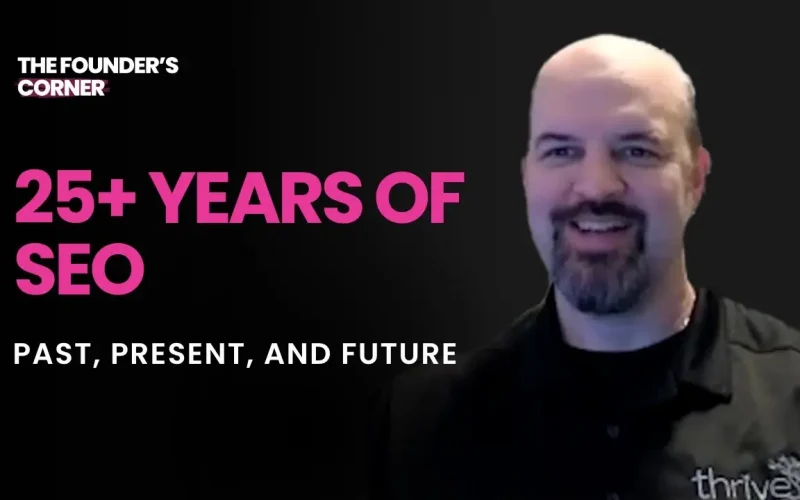
Hi, I’m Scott Orth, the Founder of Surge and of our parent company, Thrive Business Marketing.
Recently, I had a great time on Eli Clark’s podcast, titled The Founder’s Corner Podcast, talking about my 25+ years in SEO and digital marketing.
Here are some key insights from my podcast conversation with Eli:
When I first got started in digital marketing, the most valuable thing I built wasn’t a website or a portfolio. It was a contact list. Having relationships already established meant that when I eventually stepped out on my own, I had clients ready to work with me on day one.
The real challenge of running an agency is consistently delivering on what you promise. In the early days, I said “yes” to almost everything and figured out how to deliver it afterward. That scrappy mentality taught me more than any course ever could.
One thing that hasn’t changed much is Google’s dominance. For more than 25 years, they’ve held their position at the top, even as search behavior has evolved dramatically. In the early days people typed robotic, fragmented keywords. Today, natural-language processing has made search much more conversational, and SEO has become far more nuanced.
AI has pushed that evolution forward even faster. Models like ChatGPT and the rise of AI overviews have amplified long-tail search, helping users get the exact information they want without rephrasing queries three or four times. For the first time in two decades, we’re seeing AI search actually pull attention and market share away from Google.
That shift has created a sense of chaos for businesses. Every week a new AI tool launches, each one promising to “change everything.” But chaos never lasts. There will be a natural correction, and businesses will realize – just like they did with social media and every other major shift – that they still need real experts to guide strategy.
AI brings both challenges and opportunities. It will eventually settle into the same category as any other tool in your toolbox: incredibly powerful when used correctly, damaging when misused.
For content creators, AI is especially helpful as a brainstorming and outlining partner. It’s excellent for getting ideas on the page and breaking through writer’s block. But the magic happens when you use AI as the starting point, not the finished product. The right prompt matters, and so does taking the time to rewrite, reorganize, and infuse your own voice.
In my experience, the best-performing content is a blend of AI-generated structure and human refinement. Purely AI-written content tends to fall flat, both with audiences and with search engines.
Even with all the advances in AI, content is still the backbone of SEO. Discoverability across both Google and AI search heavily depends on the depth, clarity, and usefulness of what you publish. A question-and-answer format supported by real citations continues to perform extremely well in both arenas.
Fresh content is becoming even more important. AI systems prioritize recency, so posting frequently—daily if possible, weekly at a minimum—is one of the most reliable ways to stay visible.
And as AI summaries become the new “position zero,” the businesses that show up in those summaries will win. Overall website traffic may decline as AI tools answer more questions directly, but visibility inside AI search experiences will remain just as valuable.
If you’d like to watch the podcast yourself, you can find it on:
Eli also has a blog post about the podcast on his website One Bridge Accounting.