
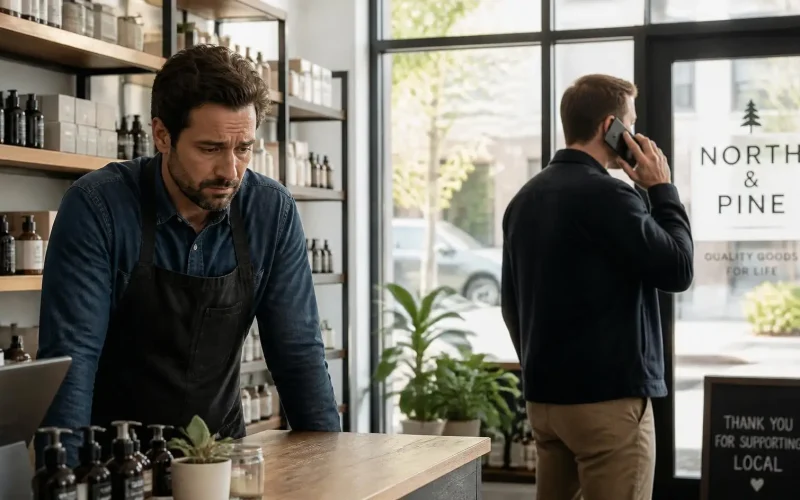
Why are people finding my business on Google but calling my competitors instead?
If people are finding your business on Google but calling your competitors instead, the problem usually is not visibility anymore. It is trust, clarity, convenience, or the experience people have immediately after they find you.
Getting into Google’s search results or local map results is an important first step. But once your business appears next to several competitors, the customer starts comparing.
Who has better reviews?
Who looks more established?
Who clearly offers what I need?
Who can help me fastest?
Who makes it easiest to call, schedule, or ask a question?
Your Google visibility may be working perfectly while your competitors are simply winning that comparison.
Why isn’t ranking on Google enough to generate calls?
Because ranking gets you considered. It does not guarantee that you get chosen.
Google explains that local search visibility is influenced primarily by relevance, distance, and prominence. A complete Google Business Profile, strong reviews, accurate business information, links, and your broader SEO presence can all influence how prominently your business appears. Google’s guidance on improving local rankings
But imagine someone searches for “plumber near me,” “divorce attorney near me,” or “air conditioning repair.”
They may see three businesses in the map results, several ads, organic listings, review ratings, photos, hours, and phone numbers within seconds.
You are not competing against Google at that point. You are competing against every other business on the screen.
That is why your website and local SEO strategy needs to do more than help people find you. It needs to give them a reason to choose you.
If your business is getting impressions and website visits but competitors are getting the calls, look at the entire experience after the search.
Are your competitors creating more trust than you are?
They might be, even if your company provides better service.
Customers rarely know which business is truly “best” when they begin searching. They use the information available to make a quick judgment.
Reviews are one of the biggest parts of that judgment.
BrightLocal’s 2025 Local Consumer Review Survey found that 74% of consumers use two or more websites when researching business reviews. It also found that consumers pay attention to the substance of reviews, including detailed experiences, photos, videos, and how businesses respond to feedback. BrightLocal’s 2025 Local Consumer Review Survey
That means a customer might find you on Google and then compare:
- Your star rating
- Your total number of reviews
- How recent your reviews are
- What customers actually say about you
- Whether you respond to reviews
- Photos of your work, employees, office, vehicles, or products
- Reviews on other websites
Google itself recommends responding to reviews and notes that thoughtful responses help businesses build relationships with customers. Google’s recommendations for managing reviews
If your competitor has recent reviews describing exactly the service the customer needs while your reviews are six months old and mostly say “Great company!”, the competitor may feel like the safer choice.
A consistent reputation and review management system can help you continuously collect new customer feedback instead of treating reviews as something you remember to ask for occasionally.
Does your website immediately explain why someone should call you?
If a visitor has to figure out what you do, who you help, or what they should do next, you are creating an opportunity for them to leave.
A strong local business website should answer several questions almost immediately:
Do you provide the service I need?
Be specific. “Comprehensive solutions for your home” is much weaker than “24-hour furnace repair in Portland.”
Do you serve my area?
Make your geographic coverage clear.
Why should I trust you?
Show reviews, years in business, certifications, guarantees, recognizable clients, memberships, case results where appropriate, or other proof.
What should I do next?
Your phone number, contact form, appointment scheduler, or primary call to action should be obvious.
Google’s page experience guidance encourages businesses to create pages that work well on mobile devices, load reliably, and make the primary content easy for visitors to identify. Google’s page experience guidance
If your competitor’s website makes the next step obvious and yours feels cluttered, vague, or outdated, ranking above them may not matter.
Thrive has also covered how reducing website friction can improve site results in its guide to reducing website bounce rates.
Is it harder to contact your business than your competitors?
This is one of the easiest problems to overlook.
A customer may like your business and still call someone else because contacting them is easier.
Suppose your website says:
“Complete the form below and someone will contact you.”
Your competitor says:
“Choose a time that works for you.”
For a customer searching at 8:30 at night, the second experience may win.
Adding online appointment scheduling, short custom contact forms, live chat, SMS options, or AI website chat tools can give customers additional ways to take action without waiting for someone to answer the phone.
Speed matters too.
Google’s mobile performance research has reported that 53% of mobile visitors leave a site when loading takes longer than three seconds. Google’s mobile site speed research
You do not want to spend months earning visibility only to lose the customer because your website is slow or difficult to use on their phone.
What if customers contact me but still end up with competitors?
Then the problem may be happening after the lead comes in.
This is where businesses often misdiagnose the problem.
They say, “Google isn’t producing good leads.”
But Google produced the lead.
The real problem is that nobody called the person back for three hours.
Or the web form went to someone’s inbox.
Or nobody followed up after the first missed call.
Or the employee answering the phone forgot to put the lead into the CRM.
A strong lead system should immediately capture the inquiry, assign it to the right person, and begin follow-up.
With Surge by Thrive’s CRM and lead capture tools, businesses can centralize new leads instead of relying on scattered email inboxes, sticky notes, spreadsheets, and individual employees’ memories.
You can then use automated workflows and email and SMS follow-up to respond faster and keep opportunities from disappearing.
The goal is not to replace personal communication.
It is to make sure personal communication actually happens.
How can I figure out exactly why people are choosing competitors?
Start by going through the same process your customer does.
Search for your primary services on your phone and compare yourself with the businesses appearing around you.
Ask:
- Which business has the strongest reviews?
- Which profile has the best photos?
- Which business description makes the service easiest to understand?
- Which website feels the most credible?
- Which website loads fastest?
- Who has the clearest phone number or call to action?
- Who lets me schedule online?
- Who gives me an immediate response after contacting them?
- Which business provides the most proof that they understand my problem?
- If I knew nothing about these companies, which one would I call?
That last question is usually the most useful.
Do not judge the experience as the business owner.
Judge it as someone who has never heard of your company.
How do I turn more Google visibility into actual customers?
Treat search visibility and lead conversion as one connected system.
Your Google Business Profile gets attention.
Your reviews build confidence.
Your website answers questions.
Your forms, chat, phone number, and calendar make it easy to respond.
Your CRM captures the opportunity.
Your automation makes sure someone follows up.
That is where platforms such as Surge by Thrive can help. Instead of using one tool for forms, another for scheduling, another for email, another for texting, and a spreadsheet to track leads, Surge can connect much of the process in one place.
If customers are already finding your business, you may not need more traffic first.
You may need to stop losing the traffic you already have.
Contact Surge by Thrive to talk about where leads may be slipping through the cracks, or request a Surge demo to see how CRM, automation, scheduling, reviews, forms, email, SMS, and lead follow-up can work together.
Frequently Asked Questions
Why do I get Google impressions but very few phone calls?
Your listing may be appearing for searches without giving customers enough reason to choose you. Compare your reviews, photos, offer, website messaging, contact options, and overall credibility against the businesses appearing beside you.
Can better reviews increase calls from Google?
Yes. Reviews help customers evaluate risk and compare businesses. Google also states that review quantity and positive ratings can contribute to local prominence. Google’s local ranking documentation
Should I focus on SEO or website conversion first?
Usually both need to work together. SEO helps the right people discover your business. Conversion improvements help turn that visibility into phone calls, appointments, and leads. You can learn more about the broader role of local visibility in Thrive’s local SEO resources.
What’s the biggest mistake businesses make after ranking on Google?
Assuming the job is finished. Ranking creates an opportunity. Your reputation, website, response speed, follow-up process, and customer experience determine how much of that opportunity becomes revenue.