
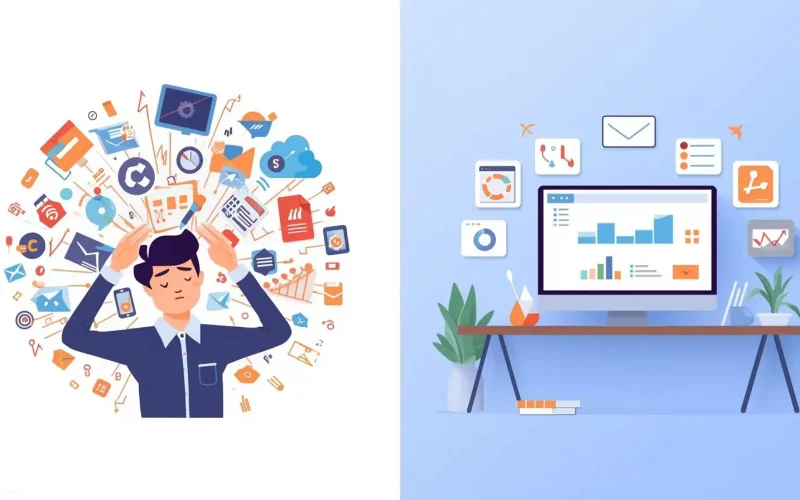
Why does my business feel chaotic even though I have marketing tools?
If you are a small business owner, you have probably had this moment.
You bought marketing software. Maybe several tools. One handles email. Another does scheduling. Another runs ads. Something else collects leads.
Yet your business still feels messy.
Leads slip through the cracks. Messages get missed. Appointments get double booked. Marketing feels like constant busy work instead of real growth.
So what is going on?
The problem usually is not the tools themselves. The problem is how they are connected, or more accurately, how they are not connected.
Let’s break down why businesses feel chaotic even when they have marketing software and what actually fixes the problem.
Why do marketing tools sometimes create more chaos instead of less?
Most businesses adopt tools one at a time.
You add email software. Later you add a CRM. Then scheduling. Then forms. Then social media tools.
Each solves one small problem, but together they create a bigger one. They do not communicate well with each other.
This is called tool fragmentation.
According to research from HubSpot, businesses often use dozens of disconnected marketing apps, and that fragmentation causes lost data, duplicated work, and poor customer experience.
https://blog.hubspot.com/marketing/martech-stack
When tools are disconnected, several things happen.
- Leads land in different systems
- Customer conversations happen in multiple places
- Your team manually copies information between tools
- Automation breaks because systems cannot trigger each other
Instead of simplifying your business, your technology stack becomes a second job.
This is one of the biggest reasons businesses feel chaotic even while using modern software.
Why do leads fall through the cracks?
Leads are often lost because there is no central place tracking them.
Imagine this scenario.
Someone fills out a form on your website. Another person sends a Facebook message. A third calls your office and leaves a voicemail.
Where do those leads go?
If the answer is “different places,” then you have the problem.
A centralized CRM fixes this issue by capturing every lead in one place.
With a system like Surge CRM and Lead Capture, leads from your website, ads, social media, and forms all flow into one pipeline.
Once captured, they can trigger automatic responses, reminders, and follow ups.
Research from Harvard Business Review found that companies that respond to leads quickly are dramatically more likely to qualify them and convert them.
https://hbr.org/2011/03/the-short-life-of-online-sales-leads
When leads sit unnoticed across multiple platforms, response time slows and opportunities disappear.
Centralizing lead capture is one of the fastest ways to remove chaos.
Why does follow up feel so inconsistent?
Many businesses rely on manual follow up.
Someone fills out a form and the team tries to respond later. Maybe they send an email. Maybe they forget. Maybe they respond two days later.
That inconsistency creates stress internally and a poor experience for potential customers.
Automated workflows solve this problem.
With tools like Workflow Automations, you can automatically trigger actions when someone becomes a lead.
For example:
- Send an instant text message confirming their request
- Send an email with helpful information
- Notify your team
- Schedule a follow up task if no response occurs
Automation research from McKinsey shows that many business processes can be automated, significantly improving efficiency and reducing human error.
https://www.mckinsey.com/capabilities/operations/our-insights/automation-technologies
Instead of your team chasing tasks all day, systems handle routine communication automatically.
Why does customer communication feel scattered?
Another reason businesses feel chaotic is that conversations happen across many channels.
Customers might contact you through:
• Email
• Website forms
• Text messages
• Chat widgets
• Social media
• Phone calls
If these conversations stay in separate tools, your team loses context.
This is where integrated communication systems become powerful.
For example:
• Custom Forms capture structured information
• AI Chat Widgets answer questions instantly
• Email & SMS Marketing keeps follow ups consistent
When all conversations route through the same system, your team sees the full customer history in one place.
Customers also experience faster responses, which builds trust.
Why does scheduling become a nightmare?
Scheduling chaos is incredibly common.
Someone books through Calendly. Another person calls the office. Another sends an email asking for availability.
Now your team is juggling calendars manually.
The fix is simple but powerful.
Online scheduling tools connected to your CRM.
With a system like Appointment Scheduling, customers can book available times directly. Automated reminders reduce no shows. Calendar events sync across your team.
Research from healthcare and service industries shows appointment reminders can significantly reduce missed appointments.
https://www.ncbi.nlm.nih.gov/pmc/articles/PMC3638597/
Removing manual scheduling instantly reduces operational stress.
Why does marketing still feel disconnected from revenue?
Another major cause of chaos is when marketing results are unclear.
You might be running SEO, ads, social media, and email campaigns. But it is hard to tell what actually drives revenue.
Your website is the center of that system.
A properly structured website should capture leads, route them into your CRM, trigger automation, and track conversions.
This is where integrated platforms matter.
For example, SEO Websites are designed not just to attract traffic but to convert visitors into leads and customers.
Google reports that businesses with strong online presence and optimized websites see significant improvements in visibility and customer engagement.
https://developers.google.com/search/docs/fundamentals/seo-starter-guide
Without conversion systems, marketing traffic becomes wasted opportunity.
How do reviews and reputation affect business chaos?
Your reputation is another piece of the puzzle.
Many businesses struggle to track reviews across platforms like Google, Yelp, and Facebook.
Responding manually across sites becomes time consuming and inconsistent.
Reputation management systems simplify this.
Using tools like Reputation Management, businesses can:
- Request reviews automatically after services
- Monitor reviews across platforms
- Respond quickly to feedback
- Improve search visibility
Research from BrightLocal shows that 87 percent of consumers read online reviews before choosing a business.
https://www.brightlocal.com/research/local-consumer-review-survey/
When reputation management is automated, businesses reduce workload while strengthening trust.
What actually fixes marketing chaos?
The real solution is not adding more tools.
It is replacing disconnected tools with a unified system.
When marketing software is built as one connected platform, several things change immediately.
Leads flow into one place.
Automation triggers instantly.
Scheduling runs smoothly.
Customer conversations stay organized.
Marketing results become measurable.
This is exactly why platforms like Surge exist.
Instead of juggling multiple subscriptions and integrations, Surge combines:
• CRM and lead capture
• Email and SMS marketing
• AI chat widgets
• Scheduling
• Workflow automation
• Reputation management
• SEO websites and forms
All working together.
If your business feels chaotic even with marketing tools, the issue is usually not effort or strategy. It is the systems behind the scenes.
If you want to see how an integrated platform can simplify your marketing and operations, you can request a demo here:
Or reach out directly to discuss how your business could streamline its systems:
Many business owners discover that once their systems are connected, the chaos disappears and growth becomes much easier to manage.