
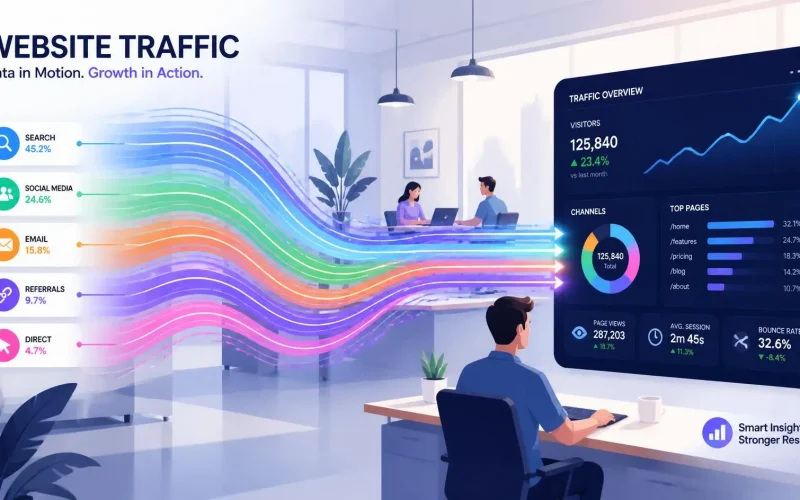
Why does my website bring in visitors but not enough serious inquiries?
Your website may be attracting attention without giving the right people enough clarity, confidence, or motivation to contact you.
Traffic alone does not create customers. A visitor still needs to recognize that you solve their specific problem, trust your business, understand what happens next, and have an easy way to take action. When any part of that path is weak, traffic can rise while serious inquiries stay flat.
Are you attracting the right website visitors?
The first question is not how many people are visiting. It is whether the people arriving are a good match for what you sell.
A website can generate plenty of visits from broad blog topics, loosely related searches, social media clicks, or poorly targeted ads. Those visitors may improve your traffic report without having a real need, budget, location fit, or intention to contact your business.
Compare traffic sources with actual leads. Look at which search terms, ads, pages, locations, and campaigns produce qualified conversations rather than clicks alone. Google’s Search Essentials guidance recommends creating helpful, people-first content and using the words people search for in prominent places such as titles and headings.
This is where a strong SEO website strategy matters. The goal is not traffic for traffic’s sake. The goal is visibility for searches that signal a real problem, active interest, or buying intent.
Does each page quickly explain why someone should choose you?
A visitor should be able to tell within a few seconds who you help, what problem you solve, and what action to take next.
Many websites open with phrases such as “quality service you can trust” or “solutions tailored to your needs.” Those statements sound pleasant, but they could describe almost any company. A serious prospect is looking for specifics.
Your most important pages should answer:
- Who is this service for?
- What problem does it solve?
- What makes your approach different?
- What results can the customer expect?
- What should the visitor do next?
Nielsen Norman Group recommends that a homepage communicate a clear value proposition through a descriptive tagline and content that reflects the audience’s needs and goals. Its research also notes that users often leave pages quickly when the value is unclear.
Clear copy helps the right visitor recognize that they are in the right place. It also helps less-qualified visitors decide whether your service fits their needs.
Does the page match what the visitor expected to find?
A person who searches for a specific service should land on a page about that service, not a generic homepage that makes them hunt for answers.
Someone searching for emergency plumbing help, a business immigration attorney, or commercial HVAC repair has a specific need. The landing page should continue the conversation that started in search, an advertisement, an email, or a social post.
Google Ads recommends choosing landing pages that closely match the ad and keywords. Google also evaluates landing page experience based partly on how relevant and useful the page is to the person who clicked.
Review your highest-traffic pages and ask: “Would someone arriving here feel that this page was built for the exact problem they are trying to solve?”
When the answer is no, improve or create dedicated service, industry, location, and campaign pages.
Are you making it too difficult to contact your business?
Visitors are less likely to convert when pages are slow, forms feel intrusive, buttons are hard to find, or the next step looks like too much work.
Google has reported that 53% of mobile visits may be abandoned when a page takes longer than three seconds to load. Speed is therefore a lead-generation issue, not just a technical website issue.
Forms create another common problem. A first-contact form usually does not need every detail your team may eventually want. Nielsen Norman Group advises reducing effort and removing unnecessary fields because every additional field gives users another reason to stop.
A practical first form may ask for:
- Name
- Phone or email
- Service needed
- A short description
- Preferred contact time
With custom forms, you can collect enough information to route and qualify the lead without turning the inquiry into an interview. You can also offer appointment scheduling for people ready to choose a time.
Does your website give people enough reason to trust you?
Serious buyers usually need more proof than casual visitors.
Before reaching out, they may look for reviews, credentials, case examples, team experience, photos, pricing guidance, or a clear explanation of your process. When a website makes big claims without supporting them, interested visitors may leave to research competitors.
BrightLocal’s 2026 research reports that 97% of consumers read reviews for local businesses, while 71% use Google to read local business reviews.
Place trust signals near the decisions you want visitors to make. Add a relevant testimonial next to a form, review ratings near a booking button, or a short case example on a service page. A reputation management system can help your business consistently request, monitor, and respond to customer feedback.
A detailed review about the service being considered is more useful than a generic comment saying your team was “great.”
What happens after someone submits the form?
A website inquiry is only the start of the conversion process.
Even a qualified prospect can lose interest when the response is slow, inconsistent, or unclear. They may also contact several companies at once.
Salesforce cites research showing that teams contacting a lead within one hour were seven times more likely to have a meaningful conversation with a decision-maker than teams responding later.
Your website should connect directly to a CRM and lead capture system so inquiries are recorded, assigned, and tracked. Workflow automations can send a confirmation, alert the right employee, create a task, and continue checking in when the prospect does not reply.
You can also use email and SMS marketing to keep the conversation moving and AI chat widgets to answer common questions or collect information outside normal business hours.
Automation should not replace the human conversation. It should make sure the conversation starts quickly and does not get forgotten.
How can you tell where serious inquiries are being lost?
Track the full path from first visit to closed customer, not just traffic and form submissions.
A useful report should show:
- Where the visitor came from
- Which page they entered
- Which form, phone number, or calendar they used
- Whether the inquiry was qualified
- How quickly your team responded
- Whether an appointment was booked
- Whether the lead became a customer
This separates a traffic problem from a website, offer, or follow-up problem. A page with modest traffic and several qualified leads may be more valuable than a blog post attracting thousands of visitors who never contact you.
What should you fix first?
Begin with the pages already attracting visitors and the services that matter most to your business.
Make the offer clearer, tighten the message, add relevant proof, simplify the conversion step, and connect every inquiry to a follow-up process. Then measure whether more visitors become qualified conversations.
Surge by Thrive brings the website, forms, appointment scheduling, CRM, automation, email, SMS, reviews, and lead tracking into one connected system. To see where your website may be losing serious prospects, request a live demo or contact Surge by Thrive.