
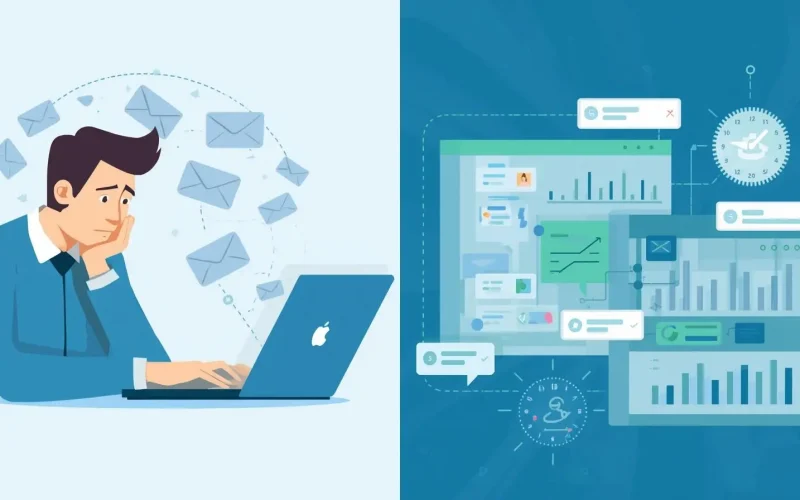
Why do my email campaigns feel like a waste of time?
If you’ve ever hit “send” on a campaign and thought… that probably didn’t do anything, you’re not alone.
A lot of business owners put real effort into email marketing and still feel like it’s not moving the needle. Low opens. Few clicks. Almost no replies. And definitely no clear connection to revenue.
The frustrating part is that email still works extremely well when it’s set up the right way. According to Litmus, email marketing can deliver an average ROI of $36 for every $1 spent.
So why does it feel like a waste of time for so many businesses?
Let’s break it down.
Why do my emails get ignored?
The short answer is this. Most emails don’t feel relevant or timely to the person receiving them.
People don’t wake up hoping to read your newsletter. They’re scanning quickly and asking one question:
“Is this worth my attention right now?”
If the answer isn’t obvious in the subject line or first sentence, they move on.
According to Campaign Monitor, average open rates hover around 21 percent across industries. That means almost 80 percent of your audience never even sees your message.
That’s not a failure of email as a channel. It’s usually a mismatch between what’s being sent and what the audience actually cares about.
Here’s what typically causes that:
- Generic messaging that could apply to anyone
- No clear benefit or outcome
- Sending at the wrong time in the customer journey
- Talking about your business instead of their problem
If your emails feel like announcements instead of conversations, they get ignored.
Am I sending emails to the wrong people?
In many cases, yes.
One of the biggest reasons email campaigns underperform is lack of segmentation.
Sending the same message to your entire list assumes everyone is at the same stage. They’re not.
Some people just found you yesterday. Others have been watching you for months. Some are ready to buy. Others are still unsure.
According to Mailchimp, segmented campaigns can drive significantly higher engagement and revenue compared to non-segmented ones.
If your list isn’t organized, your emails will feel irrelevant.
This is where having a proper CRM and lead capture system matters. Tools like Surge help you track where leads came from and what they’ve done so far using features like:
When you know who someone is and what they’re interested in, your emails stop feeling random.
Why do my emails not lead to actual sales?
Because most email campaigns stop at communication instead of conversion.
Sending an email is not the goal. Moving someone to the next step is.
If your emails don’t guide people toward something specific, they won’t turn into revenue.
Every email should answer this:
“What should this person do next?”
Examples:
- Book a call
- Reply with a question
- Click to see pricing
- Schedule an appointment
If there’s no clear path, the email becomes passive content.
This is where automation becomes powerful. Instead of sending one-off emails, you can build sequences that guide people step by step using Workflow Automations.
According to HubSpot, companies that use marketing automation see a 451 percent increase in qualified leads.
That’s not because they send more emails. It’s because they send the right emails at the right time.
Am I relying too much on one email?
This is a big one.
Most businesses send a single email and expect results. That’s like making one phone call and expecting a deal to close.
People need multiple touchpoints.
Research from Brevo shows that repeated exposure increases engagement and conversions over time.
Instead of thinking in terms of campaigns, think in terms of sequences.
For example:
- First email introduces the problem
- Second email builds trust and credibility
- Third email answers common objections
- Fourth email gives a clear call to action
Now you’re not relying on one moment. You’re building momentum.
What if people are interested but just not ready yet?
This is where most businesses lose money.
Someone might open your email, click your link, and still not take action. That doesn’t mean they’re not interested. It means the timing isn’t right.
If you don’t follow up, they disappear.
According to Invesp, nurtured leads make 47 percent larger purchases than non-nurtured leads.
This is exactly why combining email with SMS and automation works so well.
Instead of relying on one channel, you can stay in front of leads using:
You’re not chasing people. You’re staying relevant until they’re ready.
Could my website or funnel be the real problem?
Sometimes the issue isn’t the email at all.
If your email is doing its job and getting clicks, but nothing happens after that, the problem is what people see next.
Your landing pages, forms, and booking process need to be simple and clear.
If someone clicks and gets confused, they leave.
According to Google, 53 percent of users abandon a site if it takes longer than 3 seconds to load.
That’s just speed. Add poor design or unclear messaging, and conversions drop even more.
This is why your email strategy should connect directly to:
Email doesn’t exist on its own. It’s part of a system.
Why does email feel like more work than it’s worth?
Because for most businesses, it’s manual and disconnected.
You write emails, send them, check results, then start over.
That cycle feels like work because it is.
But when email is part of a system, it becomes leverage.
Instead of writing new emails every week, you build:
- Automated follow-ups
- Lead nurturing sequences
- Re-engagement campaigns
- Appointment reminders
Now your emails work even when you’re not.
This is where tools like AI Bots and automation come in. They can handle conversations, qualify leads, and even guide people toward booking without you being involved every time.
How do I know if my email strategy is actually working?
You need to track more than opens and clicks.
Those metrics can be misleading.
What really matters is:
- How many leads respond
- How many book appointments
- How many turn into customers
According to Salesforce, businesses that focus on full-funnel metrics see significantly better results than those focused on vanity metrics.
If your email platform isn’t tied to your CRM and pipeline, you’re guessing.
With a connected system like Surge, you can see exactly how email contributes to revenue through:
Now email becomes measurable, not mysterious.
What’s the simplest way to fix all of this?
You don’t need more emails. You need a better system.
Here’s a simple framework:
- Capture leads properly
Use forms and landing pages that collect useful data
Check out Custom Forms - Segment your audience
Group people based on behavior and interest - Build automated sequences
Create follow-ups that run automatically
Use Workflow Automations - Connect email to real actions
Drive people toward booking or replying
Use Appointment Scheduling - Track results that matter
Focus on revenue, not just opens
When all of this works together, email stops feeling like a chore and starts driving actual business.
Want your email marketing to actually produce results?
If your campaigns feel like a waste of time, it’s usually not because email doesn’t work.
It’s because the system behind it isn’t built to convert.
Surge by Thrive was designed to fix exactly that. It connects your emails, CRM, automation, and lead capture into one system so nothing falls through the cracks.
If you want to see how that would look for your business, you can request a demo here:
https://surgebythrive.com/live-demo-request/
Or if you just want to talk through what’s not working right now, reach out here:
https://surgebythrive.com/contact-us/
FAQ
How often should I send emails?
It depends on your audience, but consistency matters more than frequency. Weekly or bi-weekly works well for most businesses, especially when combined with automation.
Is email better than social media?
Email gives you direct access to your audience without relying on algorithms. According to OptinMonster, email converts better than social in many cases.
Should I combine email with SMS?
Yes. SMS has higher open rates, and when paired with email, it increases engagement across both channels. This is why using both inside a platform like Email & SMS Marketing can be powerful.